
Table of Contents
- What Dermal Fillers Can and Cannot Change
- Dermal Filler Recovery Timeline: From Day One to Week Two
- When You’ll See Results: Immediate vs Delayed Changes
- How to Get Natural Looking Filler Results
- Dermal Filler Side Effects and Safety: What to Know
- How Long Do Results Last and What Maintenance Looks Like
- Conclusion
- Frequently Asked Questions
Last Updated: September 14, 2026
What Dermal Fillers Can and Cannot Change
Dermal fillers before and after results are the clearest way to understand what these treatments can realistically do. Dermal fillers are injectable gels, most often made of hyaluronic acid, that restore lost volume and soften folds by adding soft tissue filler beneath the skin. At Gentle Glow MedSpa, our team frames every consultation around one honest idea: fillers restore and balance, they do not rebuild a face.
They cannot tighten loose skin, erase deep textural damage, or replace the lifting effect of surgery. What they do well is restore mid-face volume, soften nasolabial folds and marionette lines, add subtle lip augmentation, and sharpen jawline definition. Understanding that boundary is the difference between a refreshed look and an overfilled one.
Common Treatment Areas: Cheeks, Lips, Jawline, and Folds
Cheeks, lips, the jawline, and the folds around the mouth account for most filler treatments. Each area has a different goal, and each responds to a different technique.
- Cheeks and mid-face volume: restores the support that lifts the lower face
- Lips: adds hydration and subtle enhancement, never dramatic projection
- Jawline: improves contouring and jawline definition
- Nasolabial folds and marionette lines: softens lines without freezing expression
Facial balance is the target in every case. Filling one area without considering the others is how asymmetry correction becomes asymmetry creation.
How Hyaluronic Acid Fillers Add Volume
Hyaluronic acid fillers are gels that attract water and integrate with your existing tissue to restore volume. Because hyaluronic acid occurs naturally in the body, the body metabolizes these fillers gradually over time rather than rejecting them.
Some fillers also support collagen stimulation over the following weeks, which is why a treatment can look slightly better at the one-month mark than it does on day one. Clinical safety depends heavily on placement: filler belongs in specific planes of the face, and facial anatomy varies enough that no two treatment plans should be identical. The FDA information on dermal fillers outlines approved uses and known risks worth reviewing before any appointment.
Dermal Filler Recovery Timeline: From Day One to Week Two
The dermal filler recovery timeline is shorter than most people expect, but it is not uniform. What you see on day one is not the result, it is the result plus swelling plus the water-attracting behavior of hyaluronic acid. Understanding the arc day by day is what keeps a normal healing process from feeling like a complication.
| Timeframe | What You’ll Typically Notice | What Helps |
|---|---|---|
| Day 1 | Mild swelling, possible bruising, visible fullness, tenderness at injection points | Cool compress (not ice directly on skin), sleep with head elevated, skip makeup for 24 hours |
| Days 2-3 | Peak swelling, firmness, possible asymmetry from one-sided swelling | Avoid strenuous exercise, alcohol, and blood thinners like aspirin unless prescribed; stay hydrated |
| Days 4-7 | Swelling resolves, contours soften, any bruising shifts from purple to yellow-green | Gentle skincare, daily broad-spectrum sunscreen, avoid facial massage unless instructed |
| Week 2 | Bruising faded, filler integrated, results settling into final shape | Follow-up check if anything looks uneven or feels unusually firm |
Downtime is minimal, but it is not zero. Bruising and swelling are the two most common complaints, and both resolve on their own in most cases. A few specifics worth knowing:
- Lip treatments swell the most. Lips are highly vascular and mobile, so day-two swelling can look dramatic even when the final result is subtle. Do not judge lip work before the two-week mark.
- Cheek and mid-face treatments swell the least but can feel firm or slightly lumpy for the first week as the product integrates with tissue.
- Under-eye and tear-trough areas bruise most easily because the skin is thin and the vessels are close to the surface. Arnica and bromelain are commonly used, though evidence for them is mixed.
- Jawline and chin treatments can produce swelling that temporarily blurs the very definition you came for. It returns.
What Is Normal Versus What Warrants a Call
Most post-treatment sensations are benign. A common pattern is mild tenderness, a dull ache when you press the area, and a sense of tightness that fades within a week.
Contact your provider immediately if you experience severe pain that is disproportionate to the procedure, blanching (white patches) of the skin, mottled or dusky discoloration, vision changes, or pain that worsens rather than improves after day three. These can signal vascular occlusion, which is rare but time-sensitive. Do not wait for a scheduled follow-up.
The Psychological Side of the First Two Weeks
This is the part most before-and-after galleries skip. The first two weeks are as much an emotional adjustment as a physical one. Many patients go through a brief period of feeling “overdone” around day two or three, then swing to worry that the filler has “disappeared” by week two when swelling drops. Neither reaction reflects the final result.
A useful practice is to expect the emotional arc, not just the physical one. Patients who photograph themselves in consistent lighting before treatment and again at two weeks tend to feel far more confident about the outcome than those comparing a swollen day-two mirror image to a memory. The confidence boost that patients describe after fillers is rarely about a single dramatic change, it is about looking rested and like themselves, which is exactly what a well-managed two-week recovery produces.
When You’ll See Results: Immediate vs Delayed Changes
You will see a change immediately, but the final result takes about two weeks. This immediate versus delayed split confuses a lot of first-time patients.
Right after treatment, the area looks fuller than the finished result because of swelling and the water-attracting nature of hyaluronic acid. As swelling subsides, the true aesthetic outcome emerges. By the two-week mark, what you see is close to what you keep. If something looks uneven before then, resist the urge to judge it.
Photograph your face in the same lighting, at the same angle, at the same time of day before treatment and again at two weeks. Comparing memory to a mirror is unreliable; comparing two photos is not.
How to Get Natural Looking Filler Results
Natural looking filler results come down to restraint, anatomy, and a provider who treats your face as a whole rather than a checklist. The most common mistake we see in patients who arrive unhappy from previous treatments is overfilling in a single area without addressing the underlying volume loss.
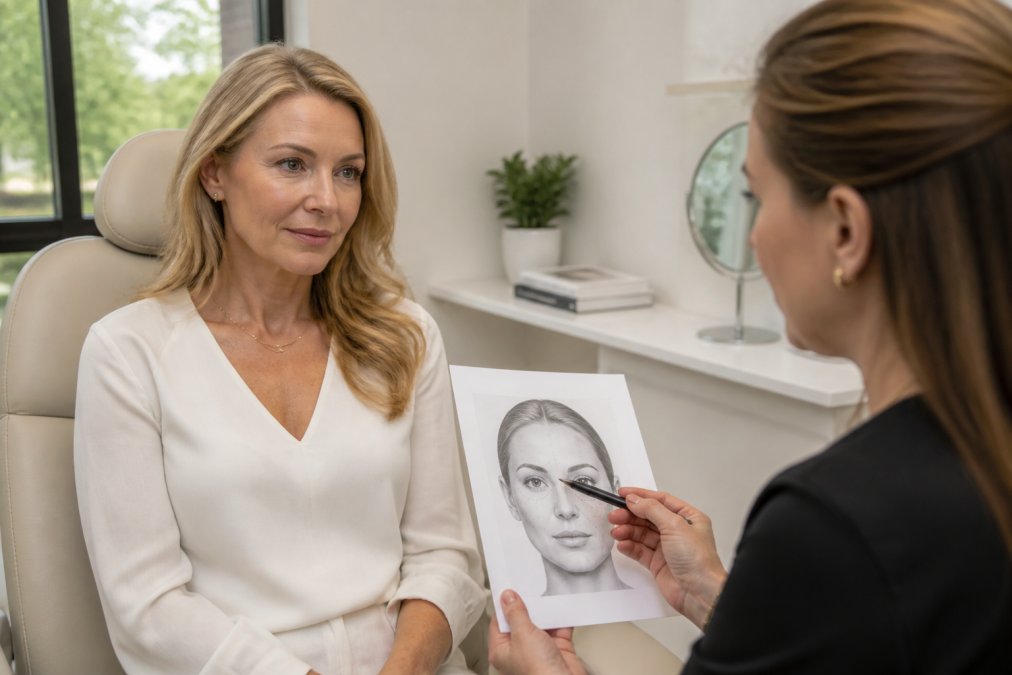
A treatment plan should start with what you want to look like, not what product is on promotion. Subtle enhancement ages well. Aggressive enhancement does not, and it is far harder to walk back.
Why Provider Expertise and Facial Anatomy Matter
Provider expertise matters more than the product chosen. The same filler placed in the wrong plane, or in the wrong amount, produces a very different result than the same filler placed well.
Board-certified providers study facial anatomy in depth because the face has distinct zones, each with nerves, vessels, and tissue planes that determine where filler can safely go. A cannula versus needle decision, for example, changes both the risk profile and the bruising pattern. This is not a treatment to price-shop on injectable alone.
Filler migration and vascular occlusion are rare but real risks. A provider who cannot explain how they would recognize and manage a vascular emergency is not a provider you should let inject your face.
Dermal Filler Side Effects and Safety: What to Know
Dermal filler side effects and safety are the questions patients ask least often and should ask first. Most side effects are mild and temporary: bruising, swelling, tenderness, and occasional lumps that settle within days.
Serious complications are uncommon but possible. Vascular occlusion, where filler blocks a blood vessel, is the most urgent and requires immediate treatment. Filler migration can occur when product moves from the intended area. Choosing a qualified injector and following post-procedure care instructions are the two biggest factors under your control. The American Society of Plastic Surgeons guidance on injectable fillers is a useful starting point for understanding what a credentialed provider looks like.
The single strongest safety decision you make is who performs the injection, not which brand of filler they use.
How Long Do Results Last and What Maintenance Looks Like
Results typically last six to eighteen months, depending on the product, the treatment area, and how quickly your body metabolizes it (Volumetric Study Shows Objective Effects of Hyaluronic Acid Filler Injections). That range is wide because the variables are real. A few grounded patterns:
- Lips fade fastest because they move constantly and have high blood flow. Most patients notice early fading around the six-month mark.
- Cheeks and mid-face hold longest, often twelve to eighteen months, because the product sits in a relatively stable plane and the area moves less.
- Nasolabial folds and marionette lines generally fall in the nine-to-twelve-month range.
- Jawline and chin vary widely with product choice; firmer, more structural fillers tend to hold longer than softer ones.
Product selection matters as much as area. Denser, more cross-linked hyaluronic acid fillers are designed to resist breakdown longer, while softer fillers used for hydration or fine lines are metabolized sooner. Your provider should be able to tell you which category your plan uses and why.
A Long-Term Maintenance Roadmap
Most content stops at “come back when you notice fading.” A more useful frame is a multi-year plan, because filler is a maintenance treatment, not a one-time fix. A common pattern looks like this:
- Year 1: Initial treatment, then a touch-up around the eight-to-twelve-month mark at the first sign of fading rather than waiting for full resolution. This keeps change gradual and avoids the “sudden refill” look.
- Year 2: Many patients find they need slightly less product per session because some collagen support has built up in treated areas. Others need the same amount. Both are normal.
- Years 3-5: The goal shifts from correction to preservation. Patients who maintain a steady schedule often look more natural at year five than patients who treat aggressively once and then stop, because gradual maintenance respects how the face ages.
A maintenance schedule matters more than any single appointment. Waiting until results disappear completely means each session has to do more work, which increases both cost and the risk of an overfilled look.
Correction and Reversal: When Results Need Adjusting
Correction and reversal are genuinely possible with hyaluronic acid fillers, which is one reason they remain the most popular choice. If a result is uneven or heavier than intended, a provider can dissolve the product with an enzyme called hyaluronidase. This is a real advantage over permanent fillers, where correction options are far more limited.
A few practical points about reversal:
- Hyaluronidase works only on hyaluronic acid fillers. It does nothing for calcium hydroxylapatite or poly-L-lactic acid products.
- Dissolving is usually fast, many patients see softening within 24 to 48 hours, but it is not always complete in one session.
- Rarely, patients have a sensitivity to hyaluronidase itself, so a provider should screen for that before using it.
- Reversal is not a substitute for good planning. It is a safety net, not a strategy.
Ask any provider what their plan is if you dislike the result before you agree to treatment. A provider who can explain their reversal protocol in plain language is a provider who has thought about your safety, not just your before-and-after photo.
The Cost-of-Ownership View
Filler pricing varies widely by region, provider credentials, and product, and it is usually quoted per syringe rather than per treatment. Because most patients need more than one syringe for a full-face plan and return for touch-ups over time, the honest way to think about filler is as an ongoing budget line, not a one-time purchase. Asking your provider for a realistic three-year estimate, not just the cost of the first appointment, is one of the most useful questions you can bring to a consultation.
Conclusion
Filler results are not a matter of luck, they are a matter of planning, technique, and restraint. Most disappointing outcomes trace back to overfilling, treating one area in isolation, or choosing a provider on price rather than expertise.
At Gentle Glow MedSpa, our precision-based approach starts with your facial anatomy and your goals, not a template. We focus on natural-looking, balanced results, personalized care tailored to your skin and features, and treatments designed to enhance your natural beauty rather than change it. If you want to see what subtle, well-planned enhancement actually looks like on faces similar to yours, book a consultation and we will walk you through it honestly.
Frequently Asked Questions
How long do dermal fillers really last?
Most hyaluronic acid fillers last 6 to 18 months, depending on the product, the treatment area, and how quickly your body metabolizes it. Lip fillers tend to fade faster, while cheek and mid-face volume can hold longer. Your provider can map a maintenance schedule so results stay consistent without overfilling.
How long does it take to see results from dermal fillers?
You’ll see some change immediately after your appointment, especially in areas like the lips or nasolabial folds. Swelling can mask the final result for 3 to 7 days, and subtle improvements from collagen stimulation may appear over 2 to 4 weeks. Most people judge their true outcome at the two-week mark.
Can dermal fillers make you look 10 years younger?
Fillers restore lost volume, soften folds, and improve facial balance, which can make you look refreshed. A 10-year change depends on your starting point, skin elasticity, and whether fillers are combined with other treatments. A personalized treatment plan focused on subtle enhancement usually delivers more believable results than aggressive overfilling.
What side effects should I expect after dermal fillers?
Common side effects include bruising, swelling, tenderness, and small bumps at the injection site. These usually settle within a few days to two weeks. Rare but serious risks include vascular occlusion, which is why board-certified provider expertise and a thorough patient consultation matter. Contact your provider if you notice severe pain, skin color changes, or vision changes.