
Table of Contents
- Why Book a Microneedling Consultation in Monmouth County
- How Microneedling Works: Collagen Induction Therapy Explained
- Preparing for a Medical Aesthetic Consultation
- Benefits of Microneedling for Crow’s Feet and Skin Texture
- Microneedling Recovery Timeline: What to Expect After Treatment
- Microneedling vs. RF Microneedling: Which Fits Your Skin Goals?
- Skin Type Suitability and Long-Term Maintenance Plans
- Frequently Asked Questions
Last Updated: September 27, 2026
Why Book a Microneedling Consultation in Monmouth County
Booking a microneedling consultation is the first step toward smoother skin, and it starts with a simple conversation about your goals. A consultation gives you a clear, honest picture of what microneedling can realistically do for your skin before you commit to anything.
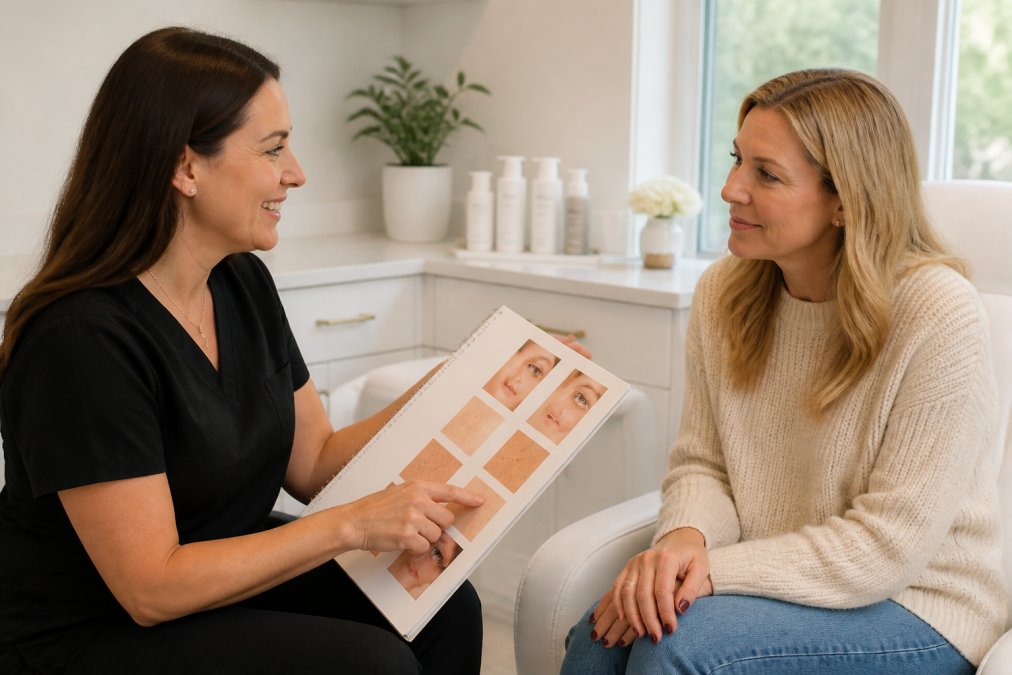
What Happens During Your Aesthetic Consultation
An aesthetic consultation is a structured skin assessment followed by a personalized treatment plan. Your provider reviews your medical history, examines your skin under proper lighting, and discusses your goals in plain language.
Expect the visit to cover:
- A dermatological assessment of skin tone, texture, laxity, and any acne scarring
- A review of medications, allergies, and past procedures
- A conversation about downtime you can realistically accept
- A written treatment plan with session count and spacing
Take photos of your skin in natural daylight before your visit. Providers can assess more accurately when they see how your skin behaves outside clinical lighting, and you get a clear baseline to compare against later.
How Microneedling Works: Collagen Induction Therapy Explained
Collagen induction therapy is a minimally invasive procedure that uses fine needles to create controlled micro-injuries in the skin, triggering the body’s natural repair response. That repair process builds new collagen and elastin over the following weeks.
Conditions Treated: Acne Scarring, Fine Lines, and Skin Laxity
Microneedling addresses several concerns at once, which is part of its appeal.
- Acne scarring: breaks down old scar tissue and encourages smoother surface texture
- Fine lines and wrinkles: supports dermal repair where collagen has thinned
- Skin laxity: improves firmness gradually through new collagen formation
- Pore size reduction: tighter surrounding tissue makes pores appear smaller
- Hyperpigmentation: can improve skin tone when combined with topical serums
Microneedling is not appropriate for active acne breakouts, open lesions, or certain skin conditions. Treating over active inflammation can spread bacteria and worsen scarring. Your provider should reschedule if your skin is flaring.
Preparing for a Medical Aesthetic Consultation
Preparation for a medical aesthetic consultation is straightforward, and it directly affects how useful the visit is. Arrive with clean skin, no makeup, and a clear idea of your priorities. But the most useful preparation starts weeks before the appointment, not the morning of it.
The Pre-Treatment Skincare Window
Most providers ask patients to pause certain actives before any needling procedure because they thin the skin barrier or increase photosensitivity. A common pattern is a 3-to-7 day pause, though the exact window depends on the product and your provider’s protocol.
What to stop, and roughly when:
- Retinoids (tretinoin, adapalene, retinol): pause 5-7 days before. They accelerate cell turnover and can make skin more reactive to needle depth.
- Exfoliating acids (glycolic, salicylic, lactic): pause 3-5 days before. Over-exfoliated skin bleeds more and heals slower.
- Vitamin C serums at high concentrations: pause 2-3 days before if they sting on application.
- Accutane (isotretinoin): disclose this. Many providers defer microneedling for 6 months after the last dose because of impaired wound healing.
- Blood thinners, aspirin, fish oil, high-dose vitamin E: disclose all of them. They increase pinpoint bleeding and bruising.
What to Avoid in the Week Before
- Sun exposure and tanning beds for at least 7 days. Tanned skin and needling do not mix well.
- Waxing, threading, or chemical peels on the treatment area for 7-10 days.
- Alcohol for 24 hours before, which can increase bruising.
- New products. Do not introduce a new serum the week of your appointment, if you react, the provider cannot tell whether it is the product or the procedure.
What to Bring and Ask
- A list of every medication, supplement, and prior aesthetic treatment
- Reference photos of results you like and dislike
- A written list of questions so the visit stays focused on your concerns
- A note on your realistic downtime window (work event? wedding? travel?)
The last point matters more than people expect. Consultations move quickly, and the questions you meant to ask often slip away. A written list keeps the visit focused on your concerns rather than the provider’s default script.
Post-Treatment Skincare: The First 72 Hours
The same discipline applies after treatment. For the first 24 hours, use only a gentle cleanser and a bland moisturizer. Skip makeup, skip actives, skip the gym. From day 2 to day 3, you can reintroduce moisturizer more liberally and add a hyaluronic acid serum, but hold retinoids and exfoliating acids for at least 5-7 days unless your provider says otherwise.
Benefits of Microneedling for Crow’s Feet and Skin Texture
The benefits of microneedling for crow’s feet come down to one advantage: it thickens skin that has grown thin. The area around the eyes loses collagen early, and that thinning creates the fine lines that deepen with every smile.
For overall skin texture, patients typically notice:
- Smoother surface feel within a few weeks
- Softer appearance of fine lines
- More even skin tone
- Improved product absorption from topical serums
Microneedling Recovery Timeline: What to Expect After Treatment
The microneedling recovery timeline is shorter than most people fear. Expect redness similar to a mild sunburn for the first day, with most of it fading within 24 to 48 hours.
| Timeframe | What You’ll See | What To Do |
|---|---|---|
| First 24 hours | Erythema, mild tightness | Gentle cleanser, skip makeup |
| Days 2-3 | Redness fading, slight flaking | Moisturize, avoid actives |
| Days 4-7 | Skin looks normal, feels smoother | Resume gentle skincare |
| Weeks 2-4 | Gradual collagen response begins | Continue post-procedure care |
| Weeks 6-12 | Visible texture improvement | Assess with your provider |
Downtime is measured in hours, not weeks, but the collagen response takes months. Judge your results at the three-month mark, not the three-day mark.
Microneedling vs. RF Microneedling: Which Fits Your Skin Goals?
The difference between microneedling and RF microneedling comes down to heat. Standard microneedling creates mechanical micro-injuries. Radiofrequency microneedling delivers energy through the needles, adding controlled heat to the dermis for a stronger tightening response.
| Factor | Microneedling | RF Microneedling |
|---|---|---|
| Mechanism | Mechanical micro-injuries | Needles plus radiofrequency heat |
| Best for | Texture, scarring, fine lines | Skin laxity, firmness |
| Comfort | Mild to moderate | Moderate, numbing used |
| Downtime | 1-2 days of redness | 2-3 days of redness |
| Sessions | 3-6 typical | 2-4 typical |
Skin Type Suitability and Long-Term Maintenance Plans
Skin Type Suitability: The Fitzpatrick Scale
Skin type suitability varies, and the Fitzpatrick scale is the standard tool providers use to assess it. The scale runs from Type I (very fair, always burns) to Type VI (deeply pigmented, rarely burns). It matters because melanin-rich skin responds to injury, including the controlled injury of microneedling, with a higher risk of post-inflammatory hyperpigmentation (PIH).
What that means in practice:
- Types I-II: Predictable redness and flushing. Lower risk of PIH. Standard protocols usually work well.
- Types III-IV: The middle ground. Most patients do well, but providers should use conservative needle depths on the first pass and build up.
- Types V-VI: Absolutely treatable, but the provider must manage needle depth, pass count, and post-care carefully. Pre-treating with a tyrosinase inhibitor (like hydroquinone or tranexamic acid, prescribed) for 2-4 weeks before the series is a common strategy to reduce PIH risk.
Long-Term Maintenance: The 12-24 Month Plan
Most microneedling content stops at “book a series.” That is where the useful part begins. Collagen remodeling continues for 3-6 months after the last session, then gradually declines. Without maintenance, you are back near baseline within 12-18 months.
A realistic maintenance arc looks like this:
| Phase | Timing | Typical Cadence |
|---|---|---|
| Initial series | Months 0-4 | 3-6 sessions, spaced 4-6 weeks apart |
| Consolidation | Months 4-9 | No treatment; let collagen mature |
| Maintenance | Months 9-24 | 1 session every 3-6 months |
| Reassessment | Month 12 and 24 | Compare baseline photos with provider |
Building the Home Regimen Around the Plan
The maintenance plan only works if the home routine supports it. A simple, sustainable stack:
- Morning: gentle cleanser, antioxidant serum (vitamin C), moisturizer, SPF 30+
- Evening: gentle cleanser, retinoid (2-3 nights per week if sensitive), moisturizer
- Weekly: one exfoliating session, never within 5 days of a microneedling appointment
Anyone who wants gradual, natural-looking improvement in skin texture and firmness without surgery or extended downtime, and who is willing to commit to a maintenance cadence rather than a one-off treatment.
Frequently Asked Questions
What should I look for in a professional microneedling consultation?
A thorough microneedling consultation should include a dermatological assessment of your skin type, tone, and specific concerns like acne scarring or fine lines. The provider should review your medical history, discuss your patient goals, and explain the treatment plan, including the number of sessions and post-procedure care. Ask about the device used, the clinical setting’s sterility practices, and whether a customized treatment approach is offered. You should leave understanding the risks, downtime, and expected results before booking.
How long is the recovery period after a microneedling treatment?
Most people experience erythema, or redness, similar to a mild sunburn for 24 to 72 hours after microneedling. Some swelling and mild sensitivity are common in the first day or two. By day three to five, most patients can return to normal activities and makeup use, depending on the depth of treatment and individual skin integrity. A personalized microneedling recovery timeline will be discussed during your consultation, as factors like treatment intensity and skin barrier condition affect healing speed.
Is microneedling effective for crow’s feet and fine lines?
Microneedling, also called collagen induction therapy, can improve the appearance of fine lines and wrinkles around the eyes, including crow’s feet. The treatment creates controlled micro-injuries that stimulate collagen production and cellular turnover, which can support dermal repair over time. Results are gradual and typically require a series of sessions. For deeper lines or significant skin laxity, a provider may recommend combining microneedling with radiofrequency or other modalities for a more customized treatment plan.
How much does a microneedling session cost in New Jersey?
Pricing for microneedling varies based on the provider, treatment area, device used, and whether it is combined with other modalities like radiofrequency. Gentle Glow MedSpa does not publish pricing online because a customized treatment plan depends on your specific skin concerns and goals. The best way to get accurate pricing is to book a microneedling consultation in Monmouth County, where the provider can assess your skin and outline a personalized plan with associated costs.
Aging skin, acne scarring, and loss of firmness rarely resolve on their own, and guessing at treatments wastes both time and money. Gentle Glow MedSpa offers personalized microneedling plans built around your skin concerns, with a precision-based approach, a sterile clinical setting, and a team focused on natural-looking results rather than dramatic changes. Book your microneedling consultation with Gentle Glow MedSpa and get a clear, honest plan for the skin you want.